Simulation Tool for Automotive ECU Software Development (SILS)GSIL

Verify ECU Software Before Hardware Completion.

Accelerate development and boost reliability with PC-based simulation and automated testing.

GSIL: Simulation Tool for Automotive ECU Software Development

Facing Challenges in ECU Software Development?

Modern automotive ECU software is increasingly complex, and testing after hardware completion often leads to delays and high costs. GSIL solves these challenges by enabling early-stage verification — without hardware.

What is SILS?

Software-in-the-Loop Simulation (SILS) allows developers to test ECU application source code — whether handwritten or auto-generated from Simulink — on a PC before hardware is ready.

Benefits include:

  • Early bug detection
  • Reduced development time and cost
  • Remote development and testing capabilities
Why SILS? - Read More(Currently available in Japanese only)

Challenges with Traditional Methods

  • Testing cannot start until hardware is complete
  • Debugging and isolating hardware/software issues is difficult
  • CI automation is nearly impossible with HILS or real hardware
  • Conventional SILS requires manual code changes and stub creation
  • Sharing environments between OEMs and suppliers raises confidentiality and cost concerns

Why Choose GSIL?

1

Early Bug Detection & Parallel Development

Shorten development cycles and allow multiple developers to work simultaneously.

2

High Reliability with Less Effort

Automated exhaustive testing ensures reliability without extra tools.

3

CI Automation

Integrate static analysis, virtual ECU generation, testing, and coverage measurement.

4

Easy Virtual ECU Setup

Minimal manual code changes, automatic stub generation, and link error resolution.

5

Cost Control & Confidentiality

DLL-based virtual environments ensure secure sharing between OEMs and suppliers.
6

Developer Training in 5 Days

GTrainer offers a software-only learning package — no hardware required.

Reduce Rework Costs

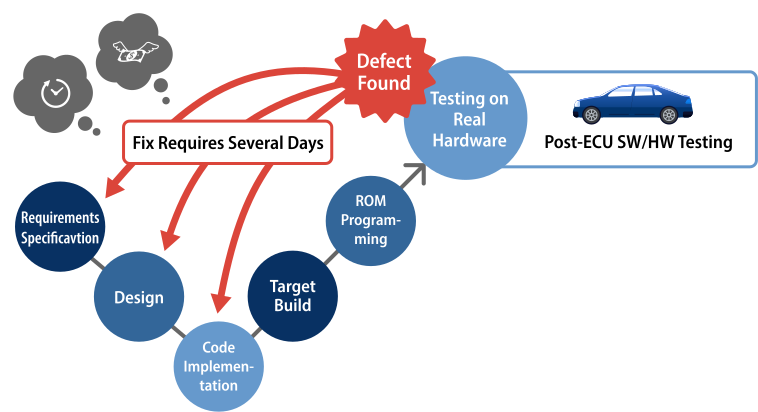
In automotive ECU software development, the V-model is commonly used. The later a defect is discovered in the process, the more steps need to be redone, resulting in significant rework costs.

The graph illustrates the cost of fixing a single defect at different development phases. Before implementation, the cost is relatively low, but it skyrockets after testing begins.
In particular, if a defect occurs after mass production and leads to a recall, it causes enormous costs and damages brand reputation. Therefore, detecting and fixing defects as early as possible is essential. This concept is known as front-loading or shift-left.

SILS enables verification of ECU application source code--automatically generated from MILS models--on a PC, and supports CI-based automated testing. By allowing easy, automated code verification before hardware completion, SILS makes software development and testing more efficient, reduces workload, and helps control rework costs.
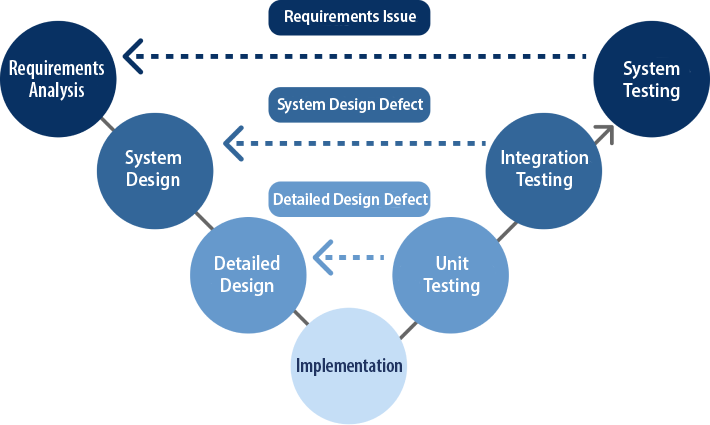
Rework man-hours for bug fixes in the V-model.

Rework man-hours for bug fixes in the V-model
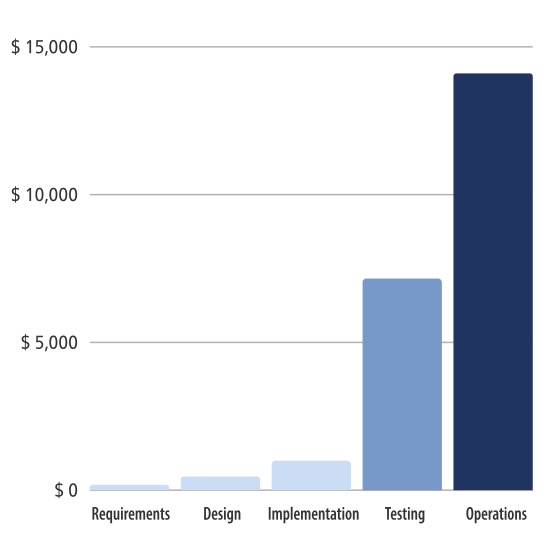
Correction cost per defect at each stage of development

Correction cost per defect at each stage of development
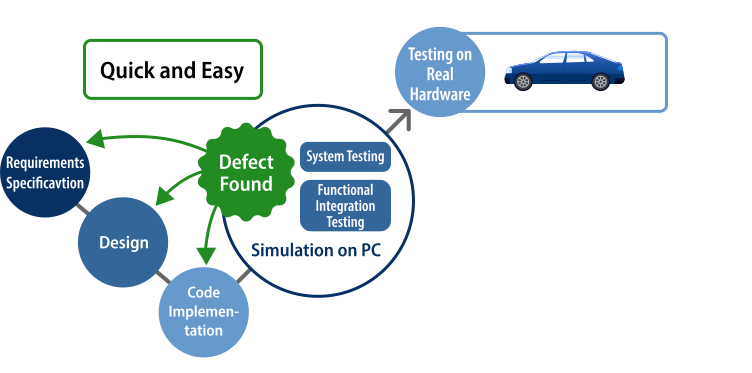
Achieve Front-Loading with GSIL

Challenges with hardware-based development:

  • Hardware is expensive and limited in quantity
  • Parallel development by multiple engineers is difficult
  • Hard to isolate software/hardware issues
  • Debugging is complex
  • Automated testing is nearly impossible

Benefits of GSIL-based development:

  • Cost-effective and supports multi-user development
  • Test anytime, anywhere
  • Easy isolation of software/hardware issues
  • Simplified debugging
  • Automated testing improves reliability

For more details on GSIL

Contact Us

Want to learn more about GSIL or have challenges in automotive ECU software development?

Demo Video


(Currently available in Japanese only)

We also provide various GSIL demo videos.

Learn more about GSIL's features and use cases through our on-demand webinars. To watch the videos, please register using the link below.

Watch GSIL Demo Videos(Currently available in Japanese only)
Key Features

  1. Virtual ECU Environment Build Assist Feature for quick setup
  2. Reuse test cases from HILS*
  3. Performance and timing verification
  4. Flexible licensing options

*HILS (Hardware-in-the-loop simulation) : A simulation method that uses an actual control device (ECU) together with a simulated controlled system.

Core Functions

  • PC-based virtual ECU simulation
  • Supports Microsoft Visual C, gcc, and Simulink auto-generated code
  • CAN communication simulation for rest-bus and real ECU tests
  • CI integration for static analysis, timing checks, coverage measurement
  • Automated exhaustive testing
  • Debugging with Visual Studio and Eclipse
  • Timing verification with chronSUITE

Use Cases

  • Combined testing of handwritten and auto-generated code with plant models
  • Unit, integration, and multi-ECU testing
  • Specification verification and runtime error detection (e.g., null pointer, buffer overrun)

Support & Related Products

Annual maintenance includes technical support, vECU build services, CI assistance, and training.

Get in Touch

For more details on GSIL

Contact Us

Want to learn more about GSIL or have challenges in automotive ECU software development?

Try GSIL for Free

Try GSIL for Free

We offer a free trial for corporations, including training and setup support.

Watch GSIL On-Demand Webinar

Watch GSIL On-Demand Webinar

Explore GSIL's features and use cases through our on-demand videos.